

What Autonomic Safety actually feels like
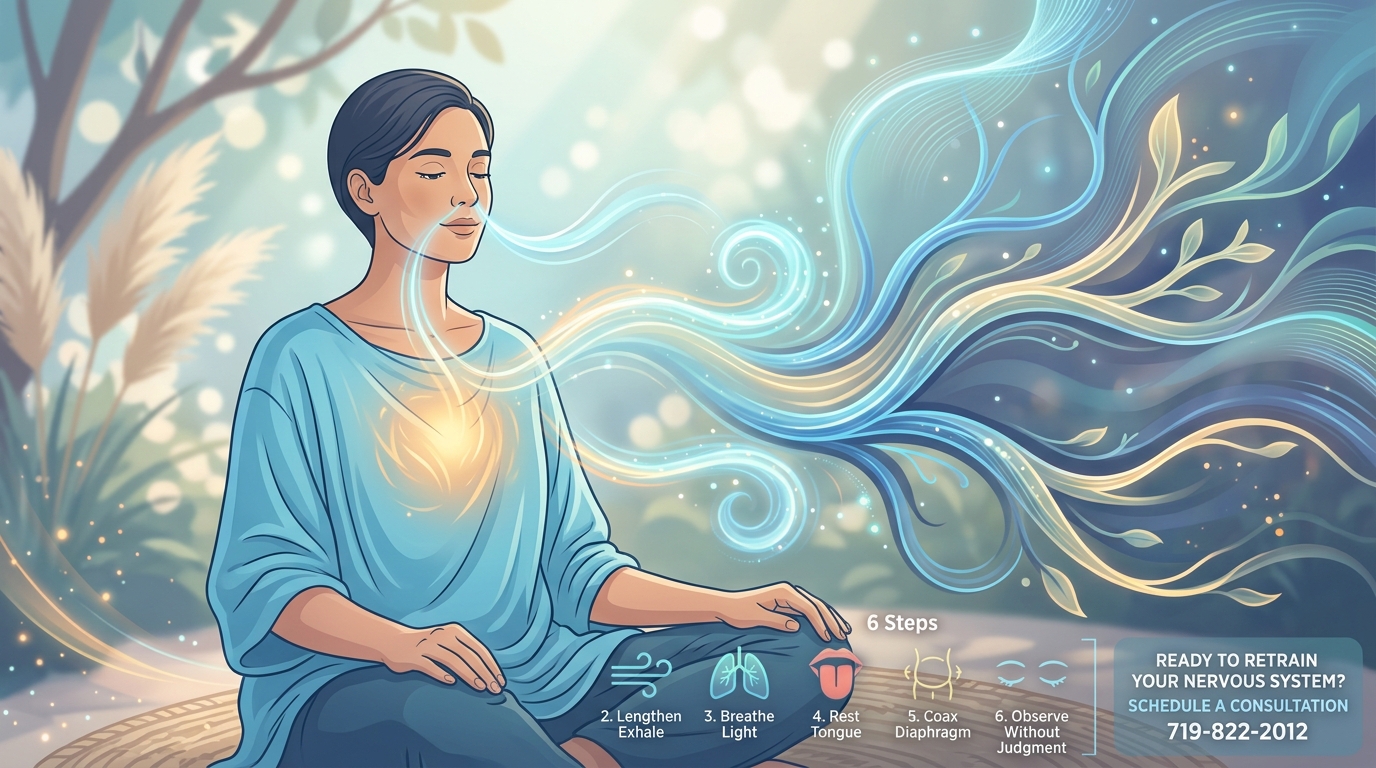
Autonomic Safety is the felt baseline where the nervous system is no longer organizing around threat. From here, attention widens. Choice returns. Therapy, learning, and change can take root.
Closed-loop cycles—fight, flight, freeze, and craving—are physiologically intelligent. They are not character flaws. The Mind-Body-Breath Method uses state-calibrated breathing so you can step out of those loops without forcing a story the body cannot yet believe.
Practice does not have to be dramatic. A few precise minutes, matched to the state you are actually in, can begin to restore Creative Agency: the capacity to respond rather than merely react.
Beyond the Threat Loop: Finding Autonomic Safety and Creative Agency Through Breath
Have you ever felt trapped in a repetitive cycle of stress, overwhelm, or habit? Perhaps your heart races, your mind spins, or you shut down entirely. In moments of high pressure, we often feel a sense of helplessness.
The Mind-Body-Breath Method offers a path out. These closed-loop cycles—whether fight, flight, freeze, or craving—are hardwired survival loops designed to protect you. Unfortunately, they keep you in your lower brain, where choice and a sense of free will are not easily accessible. To step out of these loops, rather than trying to think or will our way out, we must work with the biology of the body itself.
The Trap of "Forcing a Story"
When our nervous system is organizing around a threat, our physiology shifts. It is not a character flaw; it is a highly coordinated physical response.
This is our body’s built-in alarm system—the hypothalamic-pituitary-adrenal (HPA) axis—stuck in a frenetic loop. In this high-alert state, our breathing patterns naturally shift. Often, an environmental cue will trigger the body to slip into a fast, shallow pattern of chest over-breathing. This alters our body's natural balance and pushes our brain chemistry into hyper-vigilance, keeping us locked in a place where cognitive reasoning just doesn’t work.
Trying to anticipate, think positive, or force calm thoughts in these moments doesn't work. It asks the brain to accept a story that the body’s raw biology cannot yet believe. If your diaphragm is locked, your heart is pounding, and your breathing is shallow, your nervous system remains convinced that danger is near. The way out isn’t “thinking positive”—it must be an intervention that directly addresses physical physiology.
With Mind-Body-Breath practices, we begin well before the onset of acute distress. We train in a way that naturally fits into your daily routine using state-calibrated breathing: practices that calm your nervous system from the bottom up, without forcing a story your body isn't ready to believe.
Understanding the Intelligence of Your Nervous System
Those closed-loop cycles—fight, flight, freeze, and craving—are physiologically intelligent. Rather than fighting these states during acute stress, we practice when we are calm. We then move those practices into areas where daily stressors might otherwise activate a sympathetic state.
This is the core of being "state-calibrated": we meet the body exactly where it is, using conditioning and precise physical levers to send signals of safety directly from the body to the brain.
The Basic Breath Protocol: Working with Your Biology
First and foremost, practice when incoming stimulation is low: walking the dog, driving in light traffic, or doing the dishes. Pick moments when the body is just busy enough to occupy the surface mind, leaving your focus free to attend to the exercise.
6 Steps to State-Calibrated Breathing:
- Observe Without Judgment: Start by simply watching your breath come in and go out. If turning inward feels overwhelming at first, skip to step 2. If accessible, simply observe. This shifts awareness away from loop-driven thoughts and down into the sensory body.
- Breathe Through the Nose: Gently guide your focus to breathing entirely through your nose. Nasal breathing provides natural airway resistance, prevents the CO2 "flush" associated with mouth breathing, and releases nasal Nitric Oxide (nNO). CO2 retention and nNO act as natural calming agents, physically soothing both biology and mind.
- Lengthen the Exhale: Move your emphasis to your out-breath. The exhale is where your heart rate naturally decelerates via vagal braking, turning down cortisol and adrenaline release.
- Breathe Light: Gently reduce your breath volume by 5–30% until you feel a soft, manageable air hunger. This retrains the brainstem’s chemoreceptors to tolerate healthy CO2 levels, raising your baseline threshold against dysregulation.
- Rest the Tongue: Lightly place the tip of the tongue on the roof of the mouth, just behind the front teeth. This establishes a natural upper-airway seal and engages trigeminal sensory pathways that signal autonomic relaxation.
- Coax the Diaphragm: Bring gentle attention to belly expansion. Early in practice, the diaphragm may feel restricted. Gentle abdominal movement coaxes the main respiratory muscle back into action, stimulating the vagus nerve pathways running directly through it.
Conditioning Safety into Daily Life
To turn these 6 steps into lasting neural pathways, follow these three practical rules:
- Keep It Light: Engage the Basic Breath for just 6 to 10 cycles at a time.
- Prioritize Repetition: Practice 3 to 4 times throughout the day (totaling less than 5 minutes total). Over time, this shifts your autonomic baseline.
- Anchor to Neutral Moments: Don't attempt to breathe your way out of a panic attack on day one. Condition the breath during ordinary, low-stakes moments so the body builds a deep memory of the state.
Restoring Creative Agency
After a few weeks of consistent conditioning, accessing this breath during unexpected stress becomes second nature. Because the body has been trained to return to a calm baseline, fight-or-flight loops lose their grip much faster.
A few precise minutes, matched to the state you are actually in, restores Creative Agency: the capacity to observe and respond rather than merely react.
By meeting your body exactly where it is, you give your nervous system a direct physical experience of safety. From that felt baseline of Autonomic Safety, you can step out of closed-loop thought cycles, widen your perspective, and reclaim your power of choice.
Ready to retrain your nervous system?
Call 719-822-2012 to schedule your consultation. The Mind-Body-Breath Method meets you where you are and gives you practical tools for immediate relief.